
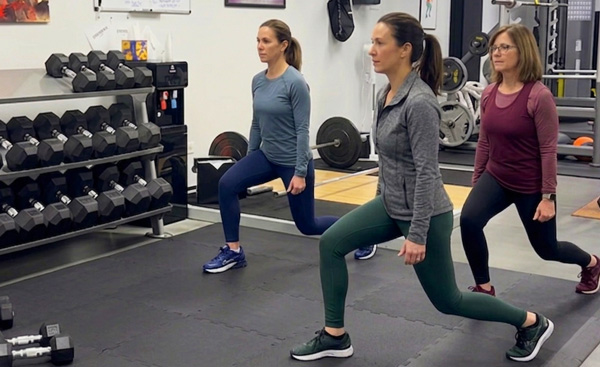
A Misunderstood Exercise – The Stationary Lunge
While the lunge may be a fantastic exercise to strengthen the lower body, it is probably one of the most poorly understood and performed exercises in homes and health clubs around the world. Therefore, in this month’s Lakewood Fitness newsletter, we will highlight some of the basic biomechanical information regarding this complex exercise in the hope that this will enable you to perform this exercise correctly and safely, reaping the plethora of benefits it has to offer. As always, prior to beginning any exercise program, please consult your physician.
Muscles Groups Targeted
When analyzing human movement, we often refer to the primary movers, the stabilizers, and the neutralizers. During the stationary lunge, the quadriceps, which are major knee extensors, are the prime movers, in both directions. Concentrically, during the up phase of the lunge to extend the knee joint with control and eccentrically, during the down phase during resisted knee flexion.
Secondarily, the hip/leg extensors (i.e., gluteus maximus/hamstrings) provide a stabilizing component for the hip/knee joints, and the neutralizers are the ankle plantar flexors through plantar flexion on the up phase and dorsiflexion on the down phase.
Additionally, the inner and outer core unit muscles work as stabilizers of the torso (ultimately protecting the integrity of your posture, think nose to toes core stability), and the hip abductors/adductors work to stabilize the hip joint medially/laterally. Yes, there is a lot going on during a lunge!
Downward/Upward Never Forward
A stationary lunge is a downward and then upward motion. Think of placing a priceless Ming vase on your head and not displacing it during the lunge. If you move forward with the head/torso, you most assuredly will be pitching your torso forward displacing the vase and probably breaking it! Therefore, before performing a lunge, connect your mind to your muscles and think “down/up,” like pushups for the lower body.
Position Yourself for Success
All exercises require a specific position in order to address the proper range of motion at the joints involved and the correct line of pull to provide the optimal load to the specific muscle group for excellent results.
Therefore, follow these guidelines for set up and performance of a stationary lunge:
• Begin with the legs in a long stride (i.e., staggered) front to back, as though you are standing on two different railroad tracks right to left, with the legs hip width apart.
• Head, neck, shoulders, knees, and toes all facing the same direction—arms suspended by your sides. Shoulders rotated back/down, rib cage lifted, navel pulled toward the spine, pelvic floor pulled up, and knees relaxed throughout the exercise.
• Place the bulk of your body weight into the heel of the front foot aligning the knee directly over the front heel and do not permit it to move in a forward direction (remember-down/up).
• Back heel should remain elevated throughout the exercise to protect the Achilles tendon.
• Slowly lower the body down toward the floor flexing hip/knee joints no lower than approximately 90 degrees at those joints.
• Then, slowly drive through the front heel extending the legs to full extension without locking the knee joints.
• Perform two/three sets of 8-12 repetitions of this exercise on two to three non-consecutive days per week.
External Loading during a Stationary Lunge
• No external load should be utilized until you have mastered the body weight version of the exercise. *Lunges are not for everyone. Those with some knee joint limitations may not be candidates for this movement pattern.
• When adding external load, begin with one moderate dumbbell or kettlebell in each hand.
• To create additional challenge, perform “suitcase” lunges holding one heavier d/b or k/b in the trailing leg hand as this will require greater balance/stability and train the nose to toes core more effectively as a result.
• Stationary Lunges may also be performed from a Smith Machine or Power Squat Rack with the barbell on the shoulders. Begin at the Smith before attempting to train with the free barbell. Always utilize a cushion on the shoulder/neck or even the hood up on a hoodie works well to prevent damage to the shoulder/neck tissues.
• Adding even further challenge, stationary lunges may be performed with the trailing leg on an elevated bench/step, with that trailing leg foot in the straps/handles of a TRX Suspension System, front or trailing leg on a BOSU or Strongboard, and once mastered, then adding external load.
By: Jackie Wright, Owner/Manager Lakewood Fitness